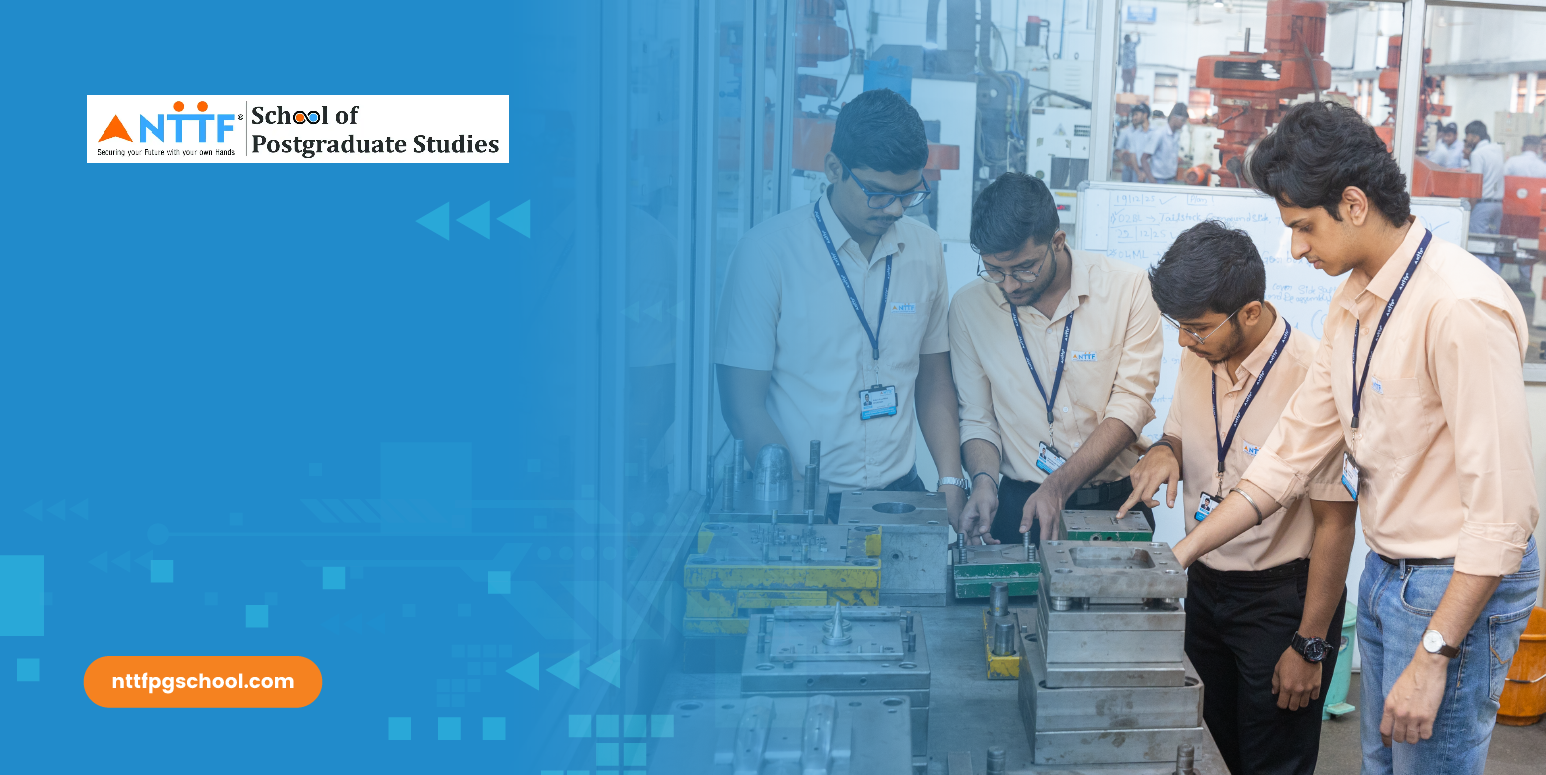
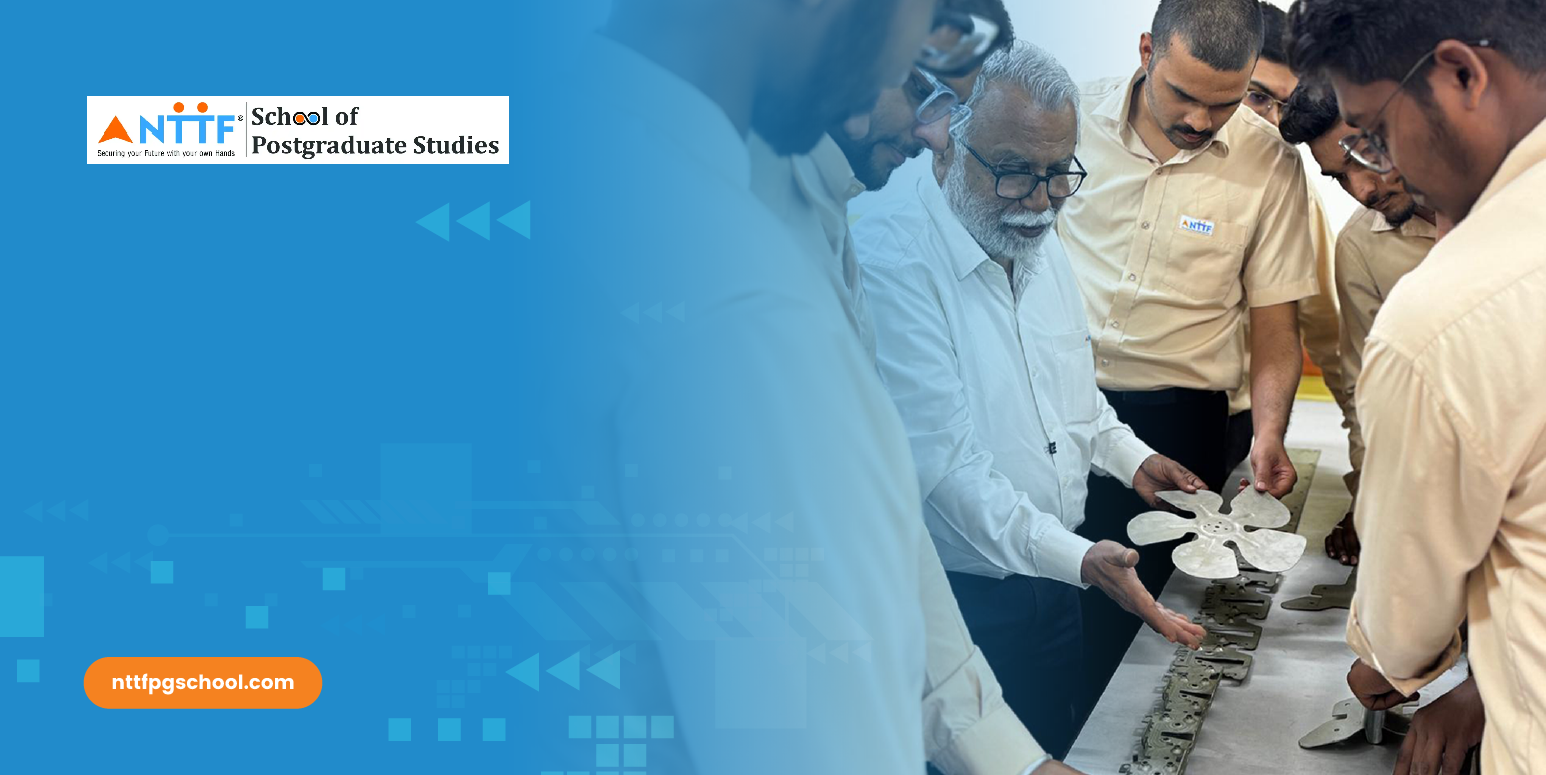
When we talk about the future of manufacturing, we are definitely not talking or speaking in metaphors. At NTTF, the experts have always believed that the factories and industries of the future will only be powered by engineers who understand not just machines, but also precision, innovation, and sustainability. These are the top requirements that will help you build a bright career in tool engineering.
This is where the NTTF Tool Engineering PG Program stands out from all other programs available in industry. We design a journey for our trainees that takes a graduate engineer and transforms them into manufacturing innovators for tomorrow.
What is Tool Engineering?
Before we find out about the program and learning outcomes, let’s first understand what tool engineering is. Basically, tool engineering is the foundation of high-volume manufacturing. It involves everything from design to development to optimization of tools, dies, jigs, and fixtures. This also helps in making mass production possible.
Tool engineering is where designs meet manufacturing reality. Whether it’s an automotive component, a medical implant, or an aerospace assembly, every precision part begins with a tool designed by a tool engineer.
At NTTF, we define tool engineering as the art and science of enabling production efficiency with accuracy, creativity, and innovation.
Details about NTTF’s PG Tool Engineering Course
Our tool engineering course at the postgraduate level is a 2-year full-time program that consists of 4 semesters. It is designed for graduates in mechanical, production, or related engineering disciplines. NTTF School of Postgraduate Studies offers this program, and every module here combines advanced theory with 65% hands-on practical exposure.
| Particulars | Details |
| Program Name | Postgraduate Degree in Tool Engineering (CP06) – PGTE |
| Duration | 2 Years (Divided into 4 Semesters) |
| Eligibility | B.E./B.Tech in Mechanical, Production, Industrial, Mechatronics, Automobile, Marine, IIE or related fields |
| Mode of Admission | Based on performance in BE + Entrance exam |
| Campus | NTTF School of Postgraduate Studies, Peenya, Bangalore |
| Practical Training | 65% practical training & 35% theory of total learning time |
| Details of Program | nttfpgschool.com/postgraduate-degree-in-tool-engineering |
This program helps bridge the gap between general engineering knowledge and specialized tool engineering expertise. The program is key to preparing graduates to work on high-precision manufacturing systems, digital tooling, and automation-integrated processes.
What You Will Learn – The Core of the Tool Engineering Course
Our curriculum is designed with the help of collaboration with industry experts and leading manufacturing organizations. Every semester is planned and structured to move students from design fundamentals to real-world manufacturing applications for better understanding of shop floor basics.
Here are the Learning Highlights of Each Semester:
| Semester | Key Learning Areas |
| I | Workshop – I, Engineering Drawing, 3D CAD, Materials & Manufacturing Processes, GD&T and Tolerance Stack Up Analysis, Jigs & Fixtures I, and Plastic Moulds |
| II | Workshop – II, Die Casting Dies, Inspection & Gauging, Tool Manufacturing & CAM, Press Tools, and Jigs & Fixtures – II |
| III | Workshop – III, Industrial Case Study and Seminar – I, Finite Element Analysis (FEA), Design for Manufacture & Assembly, Advanced press tools & Formability Analysis and Advanced Moulds & Moldflow Analysis |
| IV | Industrial Project +Seminar – II and Internship in manufacturing or tooling company |
Advanced Modules
- CAE & Rapid Prototyping
- Additive Manufacturing & Reverse Engineering
- Design for Manufacturability & Sustainability
Practical Exposure
Our students spend over 65% of their program time in workshops and CAD/CAM labs, designing, simulating, and manufacturing components under real conditions.
This practical first learning approach ensures that when you graduate, you don’t just hold a degree, but you hold industry-ready skills. These skills have helped our alumni grab the best opportunities in India and abroad.

Learning Outcomes of the PG Tool Engineering Course
By the end of this program, students develop deep technical and managerial competencies like:
- They get best career opportunities as a designer of press tools, moulds, jigs & fixtures, die casting dies and as a CAD-CAM-CAE engineer
- Students, after completion, can look forward to a career in many functional departments of industries employing Precision Engineering, such as Automotive, Consumer Durables, Medical Products & Industries involved in the business of similar products.
- Additionally, students can expect annual salaries up to Rs.9.0 lakhs based on their performance during the interview for placements.
Hence, the NTTF tool engineering postgraduate program transforms engineers into professionals who can think like designers, act like manufacturers, and lead like innovators.
Eligibility Criteria for Admission
We welcome candidates with a strong foundation in engineering and a passion for design and manufacturing.
| Criteria | Details |
| Educational Qualification | B.E./B.Tech in Mechanical, Production, Industrial, Mechatronics, Automobile, Marine, IIE, or related fields |
| Selection Process | Based on academic performance in BE + entrance examination |
| Work Experience | Freshers and working professionals can apply |
| Age Limit | No upper age limit |
| Duration | 2 years (Full-time) on campus |
Why This Program Gives You an Edge
A postgraduate degree in tool engineering is not a regular postgraduate degree; it’s a gateway qualification to leadership roles in manufacturing.
At NTTF, you don’t just learn how to make tools; you learn how to design systems that make industries run efficiently.
Your Edge:
Industry-designed curriculum
65% hands-on training
Internships & industry projects
Placement assistance with top recruiters
Global alumni network
Career Edge: What You Can Do After a PG in Tool Engineering
Completing the NTTF PG program opens doors to some of the most advanced roles in manufacturing and product development.
| Job Role | Description | Average Salary (₹/year) |
| Tool Design Engineer | Designs jigs, moulds, dies, and fixtures | ₹4–7 LPA |
| Manufacturing Engineer | Optimizes manufacturing workflows and tooling systems | ₹5–9 LPA |
| CAD/CAM Engineer | Uses CAD/CAM software for digital design and tool simulation | ₹5–10 LPA |
| Process Engineer | Ensures smooth production flow and tooling efficiency | ₹6–8 LPA |
| R&D Engineer | Develop new tools, materials, and manufacturing systems | ₹7–12 LPA |
| Production Supervisor | Leads tooling and assembly teams in production setups | ₹5–9 LPA |
(The figures mentioned are based on alumni data and industry standards.)
Graduates from NTTF often find opportunities with top recruiters such as Tata Motors, L&T, Bosch, Siemens, TVS, Bajaj, etc. These companies constantly seek professionals who understand how to turn design ideas into manufactured realities. We also have tie-ups and strong relations with top 500 companies that also add an additional benefit for our trainees to join NTTF.
Therefore, if you are an engineering graduate who dreams of building the future of manufacturing, this program is designed for you. The Tool Engineering PG Program at NTTF is designed not just for learning theory, but it’s about practical learning, creating, innovating, and leading in one of the world’s most dynamic industries.
Take the first step today and join NTTF to shape the tools that shape the world.