What is Tool Engineering?
Tool Engineering is one of the most advanced and demanded engineering courses today. It involves everything from the design, development, and production of tools, dies, moulds, jigs, to fixtures used in mass manufacturing operations. These are some essential components for enabling precision and repeatability in manufacturing processes. It could be stamping metal components for automobiles, injection-molding plastic parts, or producing complex aerospace assemblies. Individuals who graduated from this course (tool engineers) work at the intersection of design, materials science, and manufacturing processes. In short, they are the people who think, design, and launch products for use.
Not just in 2025 but even years back, manufacturers increasingly demanded professionals who not only understand the fundamentals of tooling but also the advanced methods of sustainable manufacturing, automation, and digital integration. Today there is a huge scope of tool engineering because there are thousands of products made every day that are making everyone’s life easier, and this is only raising demand for tool engineers across various industries. So, enrolling in a PG degree in tool engineering position can make you part of this future-ready workforce.
About the PG Degree in Tool Engineering at NTTF
NTTF’s postgraduate offering is a high-skill advanced program in tooling and manufacturing engineering. It is structured for over 2 years (4 semesters) and is designed for engineering graduates who wish to specialize and excel at a senior technical level in the manufacturing sector.
Key Highlights:
- Duration: 2 years full-time.
- Designed for engineering graduates in Mechanical, Production or related streams.
- Focus: Advanced tool design (press tools, plastic moulds, die casting dies), CAD/CAM/CAE integration, materials, and manufacturing processes.
- Outcome: Train students for roles in precision manufacturing, tooling, jigs & fixtures, and advanced manufacturing departments.
Basically, this is one of the most demanded and key Postgraduate Manufacturing Engineering Courses that helps to bridge the gap between general engineering education and specialized manufacturing leadership.
Eligibility Criteria
To apply for the postgraduate degree in manufacturing at NTTF following are the criteria:
- You must hold a bachelor’s degree in engineering (B.E./B.Tech) in Mechanical, Production, Industrial & Production Engineering, automobile, mechatronics or equivalent.
- Selection is based on performance in undergraduate engineering and entrance exam/interview.
- No upper age limit, making it accessible for early-career professionals as well.
Scope of the PG Degree in Manufacturing & Tool Engineering
Manufacturing has been undergoing a rapid transformation in the last few years. This transformation is adding to the demand for tooling engineers with advanced manufacturing skills. Here’s how the scope expands:
- Manufacturers are looking for professionals who understand tooling for advanced materials (composites, lightweight alloys) and processes (die-casting, injection molding, additive manufacturing).
- Tooling engineers are in high demand in various growing sectors like automotive, aerospace, consumer electronics, medical devices, and precision engineering. NTTF’s program explicitly maps to these sectors.
- A postgraduate degree also ensures you don’t just perform operations; you strategize tooling flows, optimize manufacturing cost/time, and drive innovation.
- Graduate engineers with such specializations enjoy higher employability and are often fast-tracked into roles with leadership potential in manufacturing engineering.
Fees and Duration
- Duration: 2 years (4 semesters) for the PG Degree in Tool Engineering.
- Fee (Regular category): ₹82,000 per semester at NTTF.
(Industry-nominated category fees vary.) (Fees vary for Foreign National & NRI category candidates.)
Check details: Postgraduate Degree in Tool Engineering | Advanced Tool Engineering Courses - The Postgraduate Manufacturing Engineering Courses demand a time investment of about 2 years, making them efficient pathways to advanced roles.
Subjects and Curriculum
The curriculum at NTTF is thoughtfully designed with industry experts’ suggestions, and our aim is merging theory with practice in the right way. Know what’s included:
Core Modules:
- Engineering Drawing & 3D CAD
- Advanced Materials & Manufacturing Processes
- GD&T & Tolerance Stack-up
- Jigs & Fixtures Design
- Press Tools, Die Casting, Mould Design
Advanced/Industry Modules:
- CAE & Rapid Prototyping
- Finite Element Analysis for Tool Design
- Tool Manufacturing and CAM
- Advanced Press Tools & Formability Analysis
Final Semester Project:
- Industrial internship and project work in a live manufacturing setting.
- Students often stay on as employees after the internship, illustrating the high industry alignment.
This blend ensures you graduate not just with a degree, but with actual manufacturing experience. We ensure that 65% training makes you a job-ready professional before you step out.

Careers After a PG Degree in Tool Engineering
Completing this advanced program helps in unlocking diverse roles within manufacturing engineering and tooling. Some typical career paths include:
- Tool Design Engineer – Their role includes designing moulds, dies, jigs & fixtures
- Manufacturing Engineer – Work on optimizing tooling systems and processes
- CAD/CAM/CAE Engineer – Implementing digital design and simulation for tooling.
- Process Engineer – They ensure production line efficiency and tooling performance for better workflow.
- R&D Engineer (Manufacturing) – Work on driving innovation in tool & manufacturing systems.
- Production Supervisor / Tooling Lead – They manage and oversee tooling operations and teams.
Employers span from automotive OEMs and aerospace suppliers to consumer durables companies and precision engineering firms. NTTF students have entered many such organizations.
Upcoming Trends in Tool Engineering & Manufacturing
The manufacturing landscape is continuously evolving and advancing. Tool engineering is no longer isolated from digital technologies, and it now lies at the heart of Industry 4.0.
Key trends include:
- For smarter tool design, the integration of CAD/CAM/CAE with tool engineering is now being done.
- Use of additive manufacturing (3D printing) for tool prototypes and spare tooling.
- Digital twin concept for tooling systems to simulate performance and lifecycle.
- Smart tooling with sensors to monitor tooling life and production conditions.
- Sustainable tooling materials and processes are driving cost-effectiveness and eco-design.
A PG Degree in Tool Engineering equips you to join the forefront of these trends.
Job Profiles & Salary Outlook
Job profiles mapped to this program include:
| Role | Typical Starting Salary |
| Tool Design Engineer | ₹4–7 LPA |
| Manufacturing Engineer | ₹5–9 LPA |
| CAD/CAM/CAE Engineer | ₹5–10 LPA |
| R&D/Manufacturing Specialist | ₹7–12 LPA+ |
Approximate figures based on industry reports and alumni data from tooling/manufacturing specializations.
Graduates of NTTF School of Postgraduate Studies have reported salary packages up to ₹9 lakhs based on performance.
Why Choose NTTF’s Program?
NTTF brings considerable strengths to the table for a candidate seeking a Postgraduate Degree in Tool Engineering:
- NTTF has strong industry connections, giving access to internships and placement support. With that we also have a strong alumni network of more than 1lakh graduates who are placed in leading companies across the globe, and many of them are even the employers who run their own companies. (add link to placements)
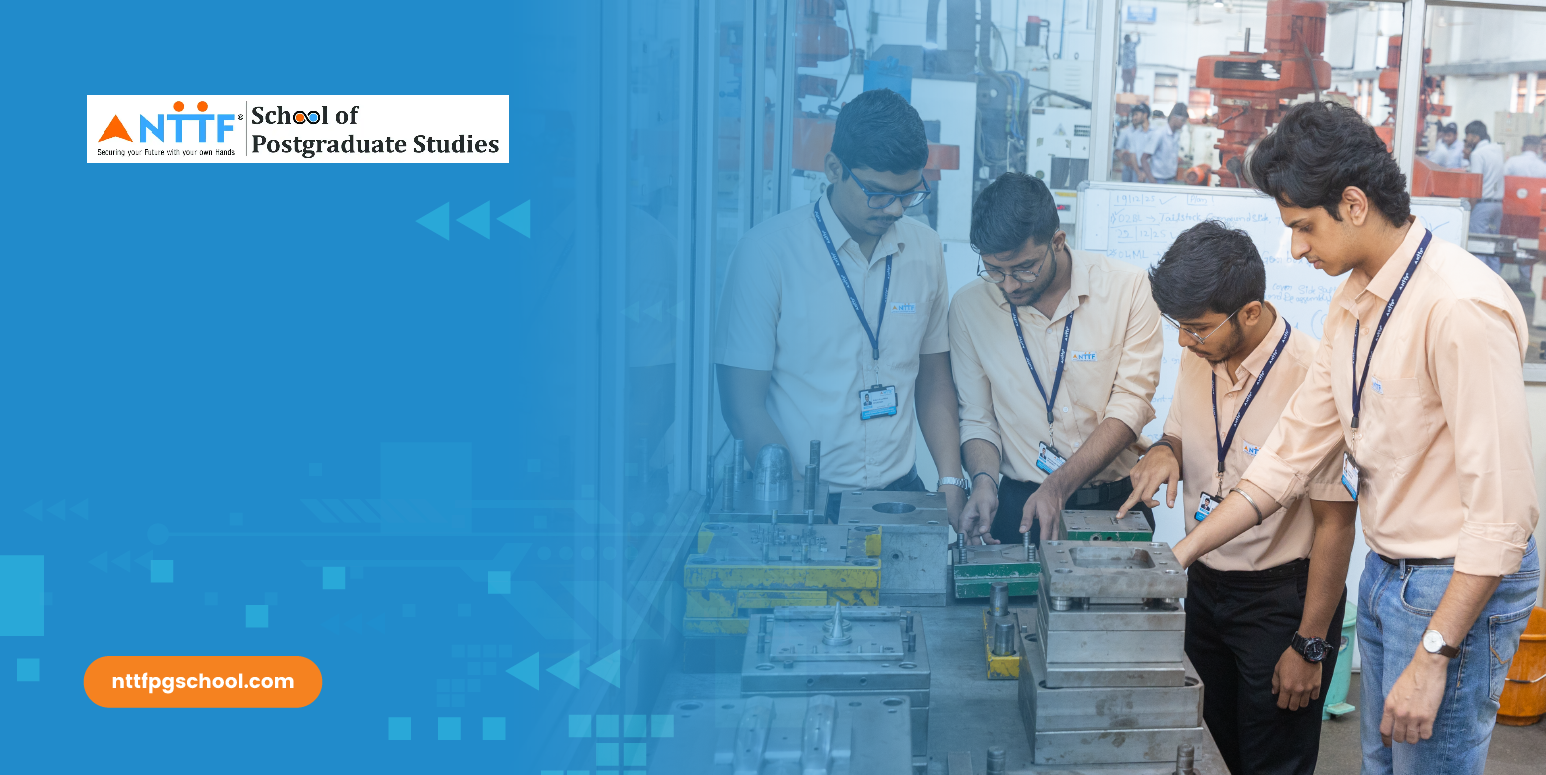
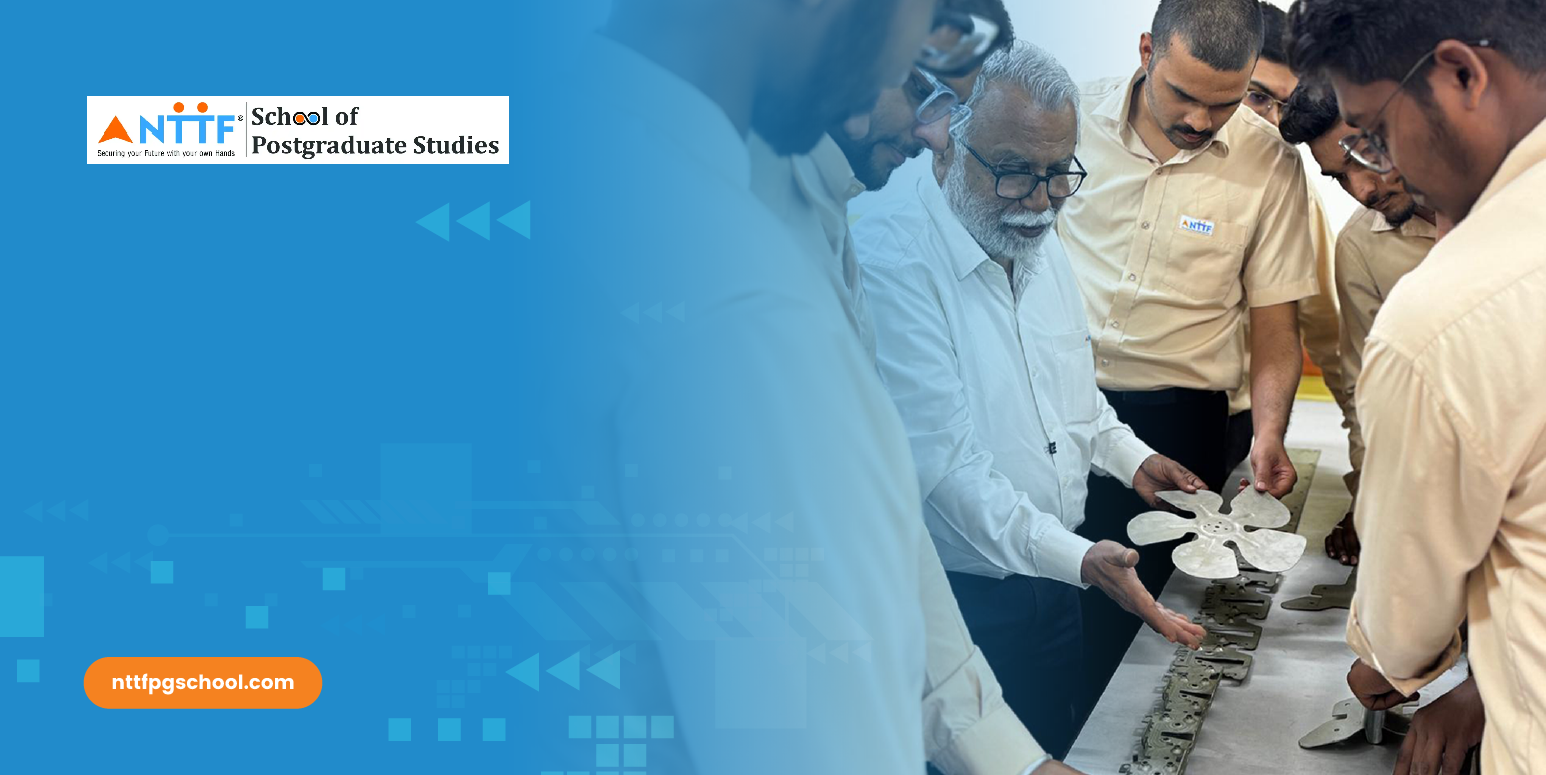
- NTTF puts high emphasis on 65% practical training with workshops, seminars, industrial visits, CAD/CAM labs, and practical projects.
- A focused curriculum for postgraduate manufacturing engineering courses, aligned to current and emerging manufacturing practices.
- Reputation of over six decades in technical training and skilling engineering talent. For mechanical graduates who want more than a general degree, this program offers a specialist edge and strong “job-readiness.”
Therefore, manufacturing is shifting faster than ever, demanding engineers who understand tooling, systems, automation, and smart processes. Choosing a PG degree in tool engineering means specializing for this future. Among postgraduate manufacturing engineering courses, NTTF’s program stands out as an industry-ready, hands-on offering built to launch your career into tooling excellence.
If you are an engineering graduate ready to shape manufacturing’s next generation, this is your pathway. Explore the program today and take your first step into advanced tool engineering and manufacturing leadership.