Today, our youth and even people in their late 20s and 30s are more concerned about job security than ever. And right in the middle of this discussion lies a burning question: can AI replace tool engineers?
The big question in 2025 isn’t just what career to pursue, or whether postgraduation is needed or not but it’s much more direct: will my degree actually get me a job in the field of AI? Yes, you read that right.
Why are such doubts even coming up? The answer lies in the buzz around Artificial Intelligence (AI), which has spread across every corner of engineering, manufacturing, and product design. From automating repetitive tasks to creating predictive models, AI is being celebrated as the ultimate game-changer.
But before we dig deeper into the arguments and the bigger picture, let’s clear one thing: AI can support tool engineers, but it cannot replace them. Tool design demands creativity, problem-solving, and a deep understanding of processes, which AI alone simply cannot replicate.
Additionally, let’s not forget, AI itself is man-made. It’s not a gift of nature; it’s a tool created by human intelligence. So, the very brain behind AI is human, which means it cannot “replace” your career as a tool designer. What it can do is support you, speed up your work, and open new opportunities for innovation.
For students and professionals, this is the biggest takeaway: a Postgraduate in Tool Engineering is still a future-proof choice. Let’s dive deeper to understand why.
What is Tool Engineering?
Before we explore AI’s impact, let’s understand the field itself.
If you are someone who enjoys working on the technical side of things, like designing, developing, and improving production mechanisms or tools, then a Postgraduate in Tool Engineering might be the right fit for you.
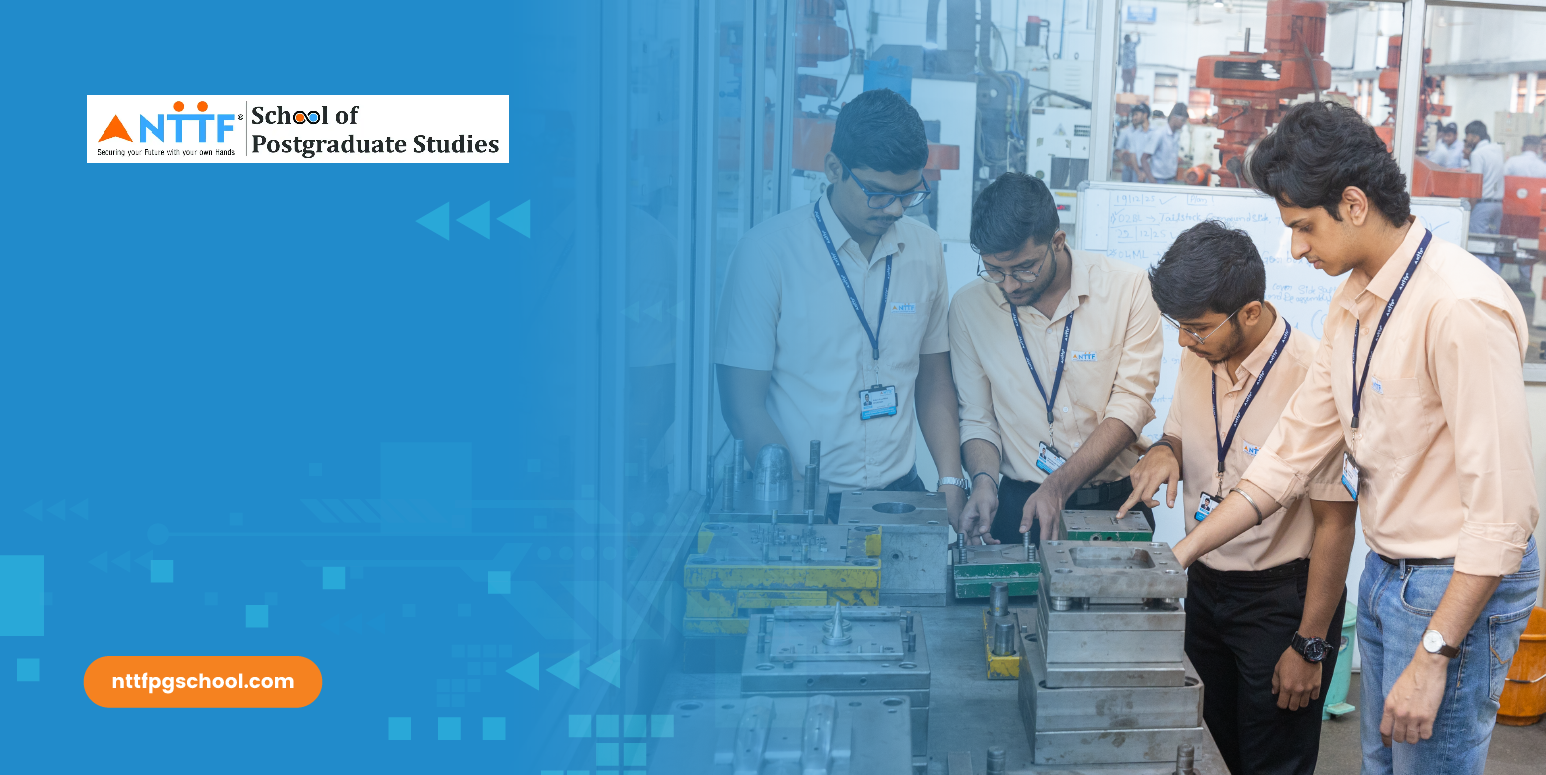
At NTTF, the Tool Engineering program is designed for graduates from mechanical, production, industrial, automobile, or mechatronics backgrounds. It’s a 2-year program that combines strong fundamentals with real-world industry exposure. Here’s what you will get:
- Tool design expertise – press tools, plastic moulds, die-casting dies
- CAD, CAM, and CAE software training
- Hands-on workshops with modern machines
- Industrial case studies and real-time projects
- Final semester paid internship with leading companies
- Practical learning throughout, not just theory, but actually designing tools used in industries
What makes this program stand out is the emphasis on practical training, which is 65% at NTTF School of Postgraduate Studies. Instead of only sitting in classrooms, you will be working on industrial challenges, designing tools that produce plastic, sheet metal, and cast metal parts.
AI in Tool Engineering – What’s Changing?
What exactly has been changing in tool engineering since AI entered the scene? The truth is, AI is not just a buzzword anymore, but it is already reshaping how tool designers and engineers work. Here’s how:
- Generative Design – In the past, creating multiple design variations for a single tool meant hours, sometimes days, of hard work. Now with AI-powered CAD software, tool engineers can generate dozens of design options in minutes. AI suggests different shapes, sizes, and structures that could work.
But AI does not magically create the “best” design. A tool engineer still has to give the right inputs, set the right goals, and verify which design actually works in the real world. In short, AI saves time, but the final judgment always rests with the human. - Simulation and Testing – Tool engineers have always relied on simulation to predict how a tool will perform under stress, strain, or heat. Earlier, this process was time-consuming and required powerful systems. Now, with machine learning, AI can run multiple simulations in a fraction of the time.
This makes decision-making faster, but again it is the tool engineer who decides which simulation output is reliable and practical. - Predictive Maintenance – One of the biggest costs in manufacturing is unexpected machine or tool breakdown. AI is solving this with predictive maintenance. This ensures quick actions and that factories don’t face sudden shutdowns. However, the decision on how to repair, redesign, or upgrade the tool still requires a skilled engineer’s eye. AI gives the signal, but humans take the action.
- Automation in Repetitive Tasks: Drafting, measurements, and standard calculations used to eat up a huge chunk of a tool designer’s time. Today, AI-powered software handles many of these repetitive, rule-based tasks automatically.
That means tool engineers now have more time to focus on the creative and innovative side of design, like solving unique industrial problems or improving tool performance. Instead of spending hours on routine details, they can direct their energy to higher-value work. - Data-Driven Optimization – Every tool designed and used in industry generates valuable data about performance, efficiency, wear, and even customer feedback. In the past, this data was scattered and often unused. Now, AI tools collect and analyze this information to give practical recommendations. This way, future tools become smarter, more reliable, and cost-effective.
Hence, when we connect all these changes, the picture becomes very clear. AI is handling repetitive and data-heavy tasks while leaving critical thinking, creativity, and decision-making to humans.
The Future of Tool Engineering in an AI-Powered World
The next decade is bright for students pursuing a Postgraduate in Tool Engineering. Instead of making tool engineers obsolete, AI will enhance their work and open new possibilities. Here’s what the future holds:
- Hybrid Roles
The tool engineer of the future will not just be an expert in conventional manufacturing but also in digital technologies like AI, CAD/CAM, and IoT. Those who can combine traditional craftsmanship with modern tech will be in the highest demand. - Faster Prototyping
AI will cut down the design cycle drastically. What once took weeks can now be achieved in days, thanks to intelligent simulation and virtual testing. Faster prototyping means faster product launches, something every industry values. - Global Demand
Countries such as Germany, Japan, India, and the USA rely heavily on precision manufacturing. As industries expand globally, the need for highly skilled tool engineers will continue to rise. AI expertise will make Indian tool engineers globally competitive. - Sustainability Focus
The future of manufacturing is green. Tool engineers will play a major role in creating tools that minimize waste, use eco-friendly materials, and reduce energy consumption. AI will provide insights, but human judgment will be critical in balancing sustainability with performance. - AI as a Partner
Instead of viewing AI as competition, tool engineers will increasingly treat it as a co-pilot. AI will handle repetitive and data-heavy tasks, while humans focus on creativity, problem-solving, and innovation.
Top 8 Future-Ready Skills for Tool Engineers in the Age of AI
To shine and make the most out of this new era, tool engineers must go beyond traditional skills. Recruiters in 2025 and coming years will expect professionals to be equally comfortable with machines and algorithms.
- CAD & CAM Mastery – Deep expertise in design and manufacturing software.
- CNC Programming & Operation – Understanding programming logic and operating CNC machines effectively.
- Simulation & Testing Tools – Using digital twins and simulation software to test tools virtually.
- Material Science Knowledge – Selecting the right material for precision, durability, and sustainability.
- Problem-Solving & Innovation – Creative thinking to design solutions for unique manufacturing challenges.
- Data-Driven Manufacturing Analytics – Interpreting data from machines to improve processes and reduce waste.
- Collaboration & Communication – Working closely with cross-functional teams like machinists, production engineers, and clients.

Why a Postgraduate Degree in Tool Engineering from NTTF School of Postgraduate Studies Matters
In 2025 and beyond, recruiters are not just asking for degrees; they are asking for skills-first professionals. And that’s exactly the edge a Postgraduate Degree in Tool Engineering gives you:
- 65% Practical Training: Work directly on CAD/CAM, CNC machining, mold design, and die design.
- Industry Mentorship: Learn from experts who bring real-world case studies into the classroom.
- Cutting-Edge Tools & Software: Get trained on AI-powered design and advanced manufacturing software.
- Global Career Pathways: Tool engineers are in demand across automotive, aerospace, consumer goods, and electronics which is why NTTF School of Postgraduates Studies team works tirelessly to place students in top companies across globe.
Hence, can AI replace tool engineers?
The truth is: AI won’t replace tool engineers, but it will reshape their role.
Here’s why:
- Tool engineering is about designing and developing tools, jigs, fixtures, dies, moulds, and machine tools, which is the foundation of modern manufacturing.
- A tool engineer ensures products are built with precision, efficiency, and cost-effectiveness.
- It’s not just about making blueprints; it’s about balancing creativity, material strength, and industrial feasibility.
If manufacturing is the backbone of the economy, tool engineers are the brains behind that backbone. Engineers who embrace AI will design smarter, faster, and more efficiently than ever. That’s why choosing a Postgraduate Degree in Tool Engineering today isn’t just relevant; it’s future-proof.
So, if you are passionate about shaping the future of manufacturing and want a career where creativity meets technology, this is your path forward.