
We all know that today manufacturing is highly driven by economy, product quality, precision, and speed. However, these are determined not just by the machines which are used but by the tools that help shape every component in each aspect. Tool design is at the core of modern manufacturing because from automotive panels and plastic housing to aerospace components and consumer products, everywhere tool design is found.
Additionally, as industries are now moving towards automation, digital manufacturing, and high-precision production, there is huge demand for skilled tool designers. This demand has not grown overnight, but because of significant growth in Industry 4.0, the need for a specialized workforce is humongous.
With this need for a skilled workforce, the current requirement for specialized postgraduate programs in tool design is an essential step. This will help engineering graduates build strong, future-ready careers in manufacturing and product development.
So, if you are also someone who wants to build a career in manufacturing and tool design, the NTTF Postgraduate Diploma in Tool Design (CP16 – PGDTD) is the right choice for a bright and fruitful future. This course is specifically designed by industry experts to bridge the gap between basic engineering education and industry-ready expertise.
Let’s find out how this program will help you develop required skill sets, why it matters, and what the eligibility, syllabus, fees, and career scope are.
What is a Postgraduate Diploma in Tool Design?
A Postgraduate Diploma in Tool Design is basically a specialized diploma that not only includes theory but also practical learning and a major focus on the design understanding, development, and application of manufacturing tools that are used in mass production.
These tools generally include everything like:
- Press tools for sheet metal components
- Plastic injection moulds
- Pressure die-casting dies
- tooling systems, Jigs, gauges, and fixtures
Unlike regular theory-focused mechanical or production engineering degrees, this program heavily focuses on hands-on learning, tool design (press tools, plastic moulds, die casting dies), tooling systems that help in increasing productivity, controlling cost, accuracy, and most importantly product quality in manufacturing industries.
Also, the postgraduate diploma in tool design helps engineering graduates equip themselves with advanced design knowledge, CAD/CAM software training, and hands-on exposure in workshops that are aligned with industrial tooling practices.
Why Should an Engineering Graduate Enroll in PG Diploma Tool Design?
1. Manufacturing Today Requires Specialized Workforce
Industries today are in continuous search for engineers who can start contributing from day one to production, tooling, and design teams. No employer is looking for months of training and then execution because tool design is a niche skill where demand consistently exceeds supply.
2. High Demand in Every Sector
Tool designers are required in:
- Automotive manufacturing
- Plastic and polymer industries
- Aerospace and defense
- Consumer electronics
- Heavy engineering and precision manufacturing
3, Quick Entry with Better Job Roles
Postgraduate diploma holders often get their first job with better titles and higher technical responsibility as compared to other fresh BE/BTech graduates.
4. Direct Pathway to Higher Specialization
This program offers lateral entry into the Postgraduate Degree in Tool Engineering (PGTE), allowing learners to advance academically without restarting from scratch.
ABOUT THE PROGRAM
Course Degree
Postgraduate Diploma in Tool Design (PGDTD – CP16)
Course Duration
- 1 Year
- Divided into 2 Semesters
NTTF’s Eligibility Criteria
To be able to pursue this course at NTTF, a candidate must have completed:
- B.E./B.Tech in:
- Mechanical Engineering
- Production Engineering
- Industrial & Production Engineering
- Industrial Engineering & Management
- Automobile Engineering
- Aeronautical Engineering
- Mechatronics
- Marine Engineering
- Polymer Engineering
- IIIE or equivalent
Age: No bar
Admission Process
- Application submission
- Evaluation of BE/BTech academic performance
- Entrance examination
- Final selection based on combined performance
Entrance Exams
- Institute-level entrance examination
Average Course Fees
| Category | Fee per Semester |
| Regular Category | ₹82,000 |
| Industry-Nominated Category | ₹1,20,000 |
| Foreign Nationals / NRI Students | US$ 2,500 |
| Miscellaneous Fees (Annual)(As per NTTF) | ₹13,000 |
Career Options
Graduates who undergo training and learning in this course are prepared for roles such as:
- Tool Designer
- Design Engineer
- CAD/CAM Engineer
- Manufacturing Engineer
- Tool Room Engineer
What is the Scope of Postgraduate Diploma in Tool Design?
Are you confused if these positions will still exist in the upcoming years as automation grows? Well, let us clear that for you because tool design will remain one of the most stable, in-demand, and essential domains in manufacturing even in the age of automation. This is because while machines evolve, tools will still be designed, optimized, and adapted for new materials, geometries, and production methods. So, to perform all these tasks, the skilled manpower will still be required in every sector.
Key scope areas include:
- High-precision tooling for automotive and EV manufacturing
- Plastic mould design for consumer goods and electronics
- Making lightweight metal components using die-casting tooling
- Digital tooling with the help of using CAD/CAM and simulation software
- For mass production, opting cost-effective tool design
Note: As industries are quickly shifting towards smart factories and Industry 4.0, it is important for tool designers to have knowledge and understanding of both traditional manufacturing and digital workflows.
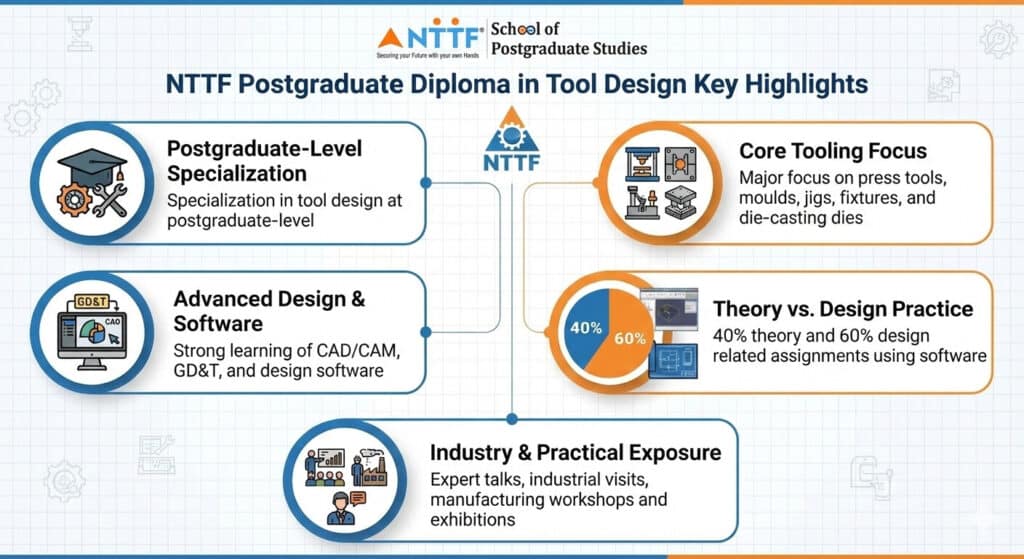
What Students Learn?
This program builds both design intelligence and manufacturing understanding.
Design Capabilities
- Press tool design for sheet metal components
- Plastic injection mould design
- Pressure die-casting die design
- Jig, fixture, and gauge design
- Application of GD&T
Manufacturing Knowledge
- Process planning for tooling
- Tool manufacturing methods
- Material selection and tooling considerations
- Cost-effective tool design practices
Digital & CAD Skills
- CAD-based tool design
- CAM fundamentals
- Tool modelling and detailing
Course Curriculum
Semester 1
- Press Tool Design
- Plastic Mould Design
- Engineering Materials for Tooling
- CAD for Tool Design
- Manufacturing Processes
- Metrology and GD&T
Semester 2
- Die Casting Die Design
- Jigs, Fixtures & Gauges
- Process Planning and Tool Manufacturing
- CAD/CAM Applications
- Industrial Project / Tool Design Project
Careers After PG Diploma In Tool Design
| Job Profile | Job Description |
| Tool Designer | Designs press tools, moulds, dies, jigs & fixtures |
| Design Engineer | They work on component and tooling design optimization |
| CAD/CAM Engineer | Develop digital models and manufacturing toolpaths from scratch |
| Manufacturing Engineer | Supports tooling integration in production work |
| Tool Room Engineer | Oversees tool manufacturing, assembly, and maintenance |
Industries Hiring
- Automotive OEMs and suppliers
- Plastics and polymer manufacturers
- Aerospace component manufacturers
- Heavy engineering firms
- Tool rooms and precision manufacturing units
Salary Potential
- Annual salaries up to ₹12 LPA, based on skills and performance
Benefits Of Pursuing This Program
- Highly focused on skill development & industry exposure
- Increases chances of employability in core manufacturing roles
- Strong foundation for advanced tool engineering
- Exposure to real-world tooling challenges & requirements
- Clear Academic Progression Path to PGTE
Upcoming Trends In Tool Design
- Digital tooling and simulation-based design
- Lightweight tooling for EV and aerospace sectors
- Integration of CAD/CAM with automation
- Advanced materials and composite tooling
- Precision tooling for high-volume manufacturing
Required Skillset
To succeed in tool design, learners should develop:
- Strong mechanical fundamentals
- Spatial and design thinking
- Attention to precision and detail
- CAD proficiency
- Problem-solving mindset
- Interest in manufacturing processes
What is NTTF Campus Placement Record?
This is one of the most important questions that graduates need to understand considering the current job market status. At NTTF each trainee is supported not only during training and internships but through structured campus placement initiatives, we connect our trainees with leading manufacturing and tooling companies. Our strong industry network and partnerships with top companies ensure access to opportunities across tooling, CAD/CAM, and manufacturing domains. Our placement record is 99%, and numbers speak for themselves because the highest packages go up to 12 LPA.
Your Direct Pathway to Step into Core Manufacturing
The Postgraduate Diploma in Tool Design is not just a regular qualification, but it’s more of a focused and advanced pathway into one of the most critical domains of manufacturing. At NTTF, by combining advanced design knowledge, 65% practical training, and industry exposure, the program prepares each engineering trainee to take on specialized roles that drive productivity and innovation.
So, anyone who is looking for a technically rich, stable, and future-relevant career in manufacturing can opt for Postgraduate Diploma in Tool Design (CP16 – PGDTD).


